According to Arthritis.Org, “arthritis” is not a single disease, but an informal way of referring to joint pain or joint disease with increased swelling and/or inflammation. There are many types of arthritis, including Inflammatory Arthritis, Infectious Arthritis, and Metabolic Arthritis. However, the two main types of arthritis are Osteoarthritis (which is the most common), and Rheumatoid Arthritis.
For those suffering from Arthritis, learning strategies and techniques to cope and adapt to the disability when performing daily self care tasks will help ease the burden of care among family members and others affected by the disability of the individual. This includes going to therapy and having an Occupational Therapist educate the person with arthritis on strategies and possibly introducing assistive devices to utilize in the household to increase their functional independence during self-care tasks.
Family and others affected by the person’s onset of arthritis can take the first steps in adjusting their lives to take care of the person by educating themselves as much as they can and utilizing resources to further their knowledge of the disability. This includes searching the internet for information, reaching out to an Occupational Therapist for home modifications and for assistive devices to help their family member with arthritis, and contacting organizations to provide resourceful information within their community to provide further assistance.
The first step in diagnosing arthritis is going to your doctor. Your doctor will consider your symptoms and perform aphysical exam to check for swollen joints or a decrease in range of motion within the affected joints. The use of blood tests and X-rays are also utilized to confirm the diagnosis and also help distinguish which the type of arthritis is present. For example, most people with rheumatoid arthritis (RA) have antibodies called rheumatoid factors (RF) in their blood, although RF may also be present in other disorders.
X-rays are used to diagnose osteoarthritis, which can typically reveal loss of cartilage and depict bone rubbing against bone. Sometimes, joint aspiration which requires using a needle to draw a small sample of fluid from the joint for testing, is used to rule out other typed of arthritis.
Treatment of arthritis generally includes rest, occupational or physical therapy, exercise, drugs, and sometimes surgery to to fix the joint damage. As for osteoarthritis, treatments can help relieve pain and stiffness, but the disease may continue to progress.
Protecting your joints is an important part of treating arthritis. An occupational therapist can teach you compensatory strategies and techniques on how to:
Avoid positions that strain your joints
Use your strongest joints and muscles while sparing weaker ones
Provide braces or supports to protect certain joints
Use grab bars in the bath
Use modified doorknobs, canes, or walkers
Use devices to help you with tasks such as opening jars or pulling up socks and zippers
Arthritis Treatment: Medicine
Arthritis treatment will depend on the nature and seriousness of the underlying condition. The main goals are to reduce inflammation and improve the function of affected joints before more serious problems occur.
The doctor will most likely prescribe acetaminophen or a nonsteroidal anti-inflammatory drug (NSAID), such as Aleve, to reduce pain and inflammation of the affected joints. The doctor may recommend corticosteroid joint injections to ease the pain and stiffness of affected joints. Results may vary from person to person as temporary relief to long-lasting suppression of symptoms. Hyaluronic acid may also be injected as it mimics normal joint fluid and can reduce pain and increase mobility. Some examples are Hyalgan, Orthovisc, and Supartz.
Arthritis Treatment: Surgery
The surgical procedure concerning arthritis treatment is Synovectomy, which is the removal of damaged connective tissue lining a joint cavity.
Surgical replacement should be a last resort when all other treatments have failed to decrease pain and inflammation and it has become too painful for the individual to tolerate. Knee and hip joints can be replaced with artificial joints made of stainless steel, plastic and ceramic materials. This also includes shoulder joints and smaller joints in the elbows and fingers.
According to Arthritis.Org, “People of all ages, sexes and races can and do have arthritis, and it is the leading cause of disability in America.” It is estimated that more than 50 million adults and 300,000 children have a form or type of arthritis. Arthritis is most common among women and occurs more frequently in people as they age.
SYMPTOMS Common arthritis joint symptoms include (but not limited to): – Swelling – Pain – Stiffness – Decreased range of motion in the affected joint
Some types of arthritis run in families. Genes can make you more susceptible to environmental factors that may trigger arthritis.
Age
As a person ages, the risk of getting arthritis increases.
Your sex
Women are more likely than men to develop rheumatoid arthritis, while most of the people who have gout, another type of arthritis, are men.
Previous joint injury
People who have injured a joint, either from sustaining a fall or from sports, are more likely to eventually develop arthritis in the affected joint.
Obesity
Carrying excess pounds puts stress on joints, particularly the knees, hips and spine. Due to the excess in body weight, those with obesity have an increased risk of developing arthritis.
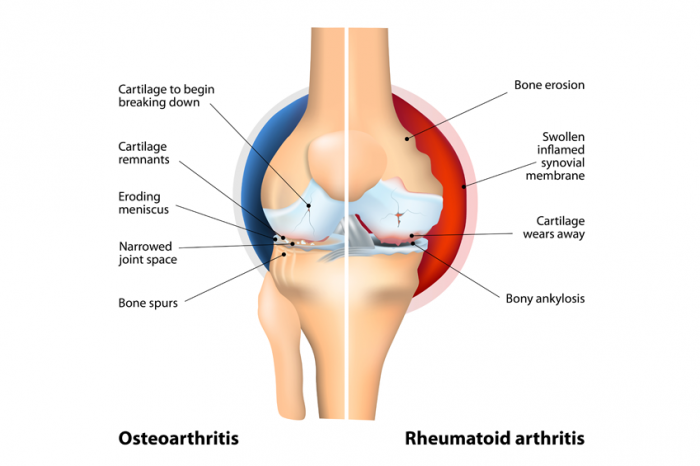
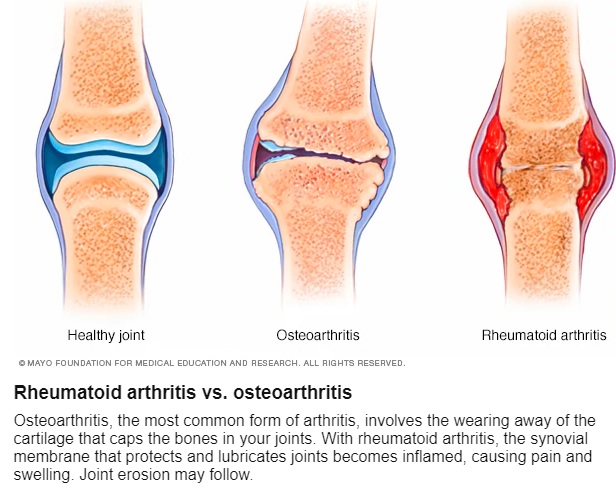
Osteoarthritis This is the most common type of arthritis. It involves the wear-and-tear damage to the cartilage in the joints. Cartilage is the hard, slick coating on the ends of bones where they form a joint. It serves as a cushion at the ends of the bones and allows for nearly friction-less joint motion. However, severe damage can result in bone grinding directly on bone, which causes pain and restricted movement. This wear and tear can happen over a long period of time (several years) or by injury to a joint or infection of a joint. Osteoarthritis also affects the entire joint. It causes changes in the bones and deterioration of the connective tissues that attach muscle to bone and provide support to that joint. It also causes inflammation of the joint lining.
Rheumatoid arthritis In rheumatoid arthritis (RA) , the body’s immune system attacks the lining of the joint capsule, which is a tough membrane that encloses all the joint parts. This lining is known as the synovial membrane, which becomes inflamed and swollen in the process. After a long period of time, RA will eventually destroy cartilage and bone within the joint.



 LIVING WITH ARTHRITIS